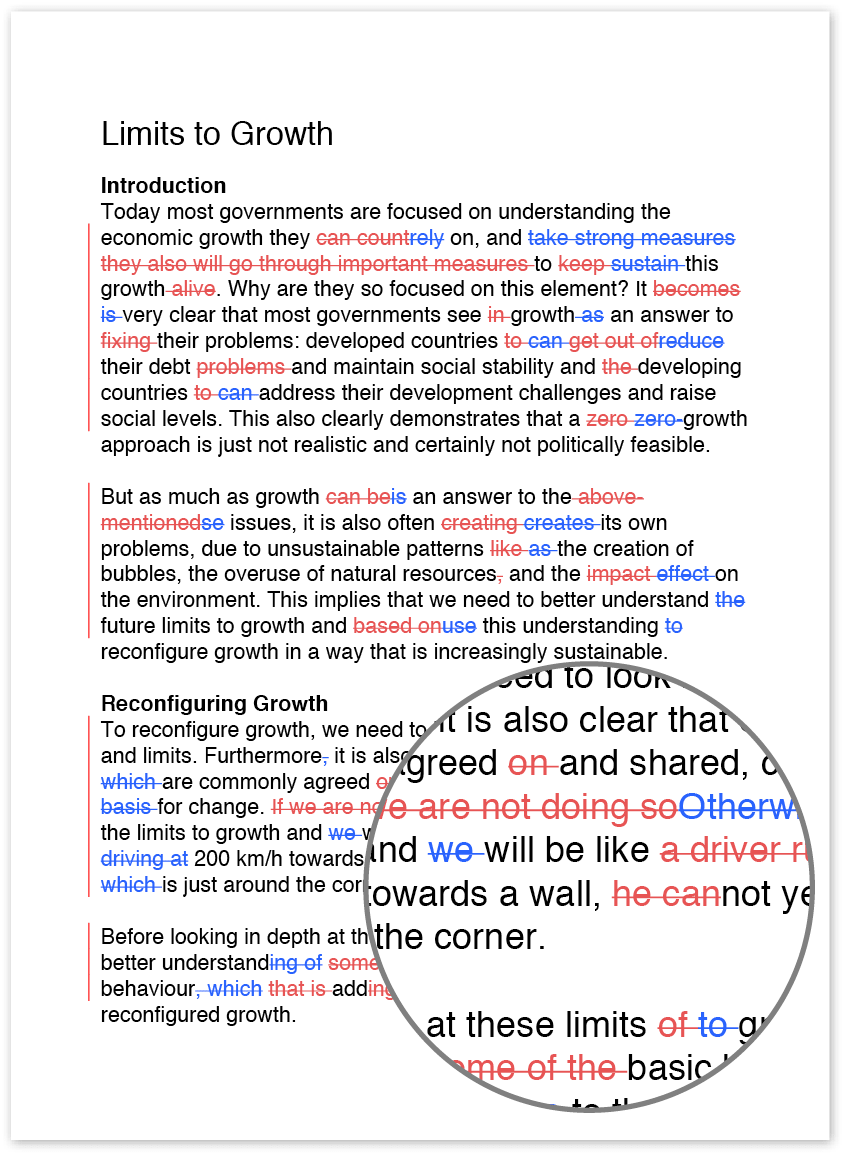

Basic English punctuation
Punctuation is a very important part of English grammar. Even though you may know all the parts of speech or how to form complete sentences, without English punctuation, you can’t indicate when a sentence ends or correctly separate items in a list. There are many different types of punctuation.
Periods, question marks, and exclamation points
These are used to end sentences. Periods indicate a declarative statement, questions marks indicate questions, and exclamation points indicate a strong emotion, such as excitement or surprise. It’s generally best not to overuse exclamation points.
Commas
Commas are one of the trickiest forms of English punctuation to learn. They are used for many reasons, including to separate clauses. It’s important to remember that you shouldn’t use a comma to separate a dependent clause from an independent clause unless the dependent clause comes first in the sentence (e.g., “I went to bed after I got home” and “After I got home, I went to bed”). For example, the sentence “I ate dinner, but still felt hungry” should not have a comma even though it includes a conjunction. Commas are also used to separate items in a list of three or more things or clauses, e.g. “I bought red, yellow, and blue paint.” Note that American English usually includes a comma after the second-to-last item in the list; this is called the Oxford comma. However, British English usually does not use the Oxford comma.
Commas can also be used to offset information from the rest of a sentence, e.g., “My dad, who loves to cook, made me dinner.” However, too many commas in a sentence can be confusing for a reader.
Colons
Colons are used to introduce a list of items or a long quote, e.g., “I went three places on vacation: Italy, France, and Spain.” They can also be used to separate two complete sentences when the second sentence expands on the meaning of the first sentence, e.g., “My mother gave me really good advice: always work hard and try my best.”
Semicolons
Semicolons are used to link two independent related clauses instead of using a comma and conjunction, e.g., “I bought a new car; it’s bright blue.” You shouldn’t use semicolons to link unrelated clauses, e.g., using a semicolon in the sentence “I bought a new car; I think it’s going to rain today” is incorrect.
Parentheses and brackets
Parentheses (which are surrounding this phrase) and brackets [which are surrounding this phrase] enclose information that explains something mentioned in the sentence or information that is an aside and that is not vital to the overall meaning of the sentence. For example, in the previous sentence, we could remove the information in the parentheses and brackets and still keep the overall meaning of the sentence.
Quotation marks
Quotation marks are used to set off direct quotes. In American English, double quotation marks (e.g., “ “) are standard, while in British English, single marks (‘ ‘) are standard. Anytime you use a direct quote from another source, you must use quotation marks.
Dashes and hyphens
The em dash (—) is used similarly to parentheses or brackets to add clarifying information or an aside phrase to a sentence. An en dash (–) is generally used to show a range of numbers (e.g., “11–19”).
A hyphen is used to connect words that appear before another word and modify it. You would say “a well-known performer” but “a performer who is well known.” Note that a hyphen shouldn’t be used for a compound modifier if the first word in the modifier ends in “-ly” (e.g., “newly painted room” and not “newly-painted room”). Hyphens are also used in fractions (e.g., “one-third”) and written-out numbers (e.g., “twenty-one”). Some words include hyphens because the hyphen reduces confusion for readers, particularly when a string of the same consonant is present (e.g., “bell-like” instead of “belllike”). If you’re not sure whether a word should be hyphenated, check your dictionary.
Apostrophes
Apostrophes are used to show possession or to make a contraction. They aren’t used to form plurals, which is a common mistake. For example, you would say, “I went to my aunt’s house” to indicate that you went to the house where one aunt lives. You wouldn’t say, “I went to see my cousin’s” to indicate that you visited multiple cousins. To make a possessive plural, place the apostrophe after the final “-s”, e.g., “I went to my parents’ house.”
In a contraction, an apostrophe takes the place of the letter or letters that have been removed. For example, “do not” becomes “don’t” and “I will” becomes “I’ll.”